
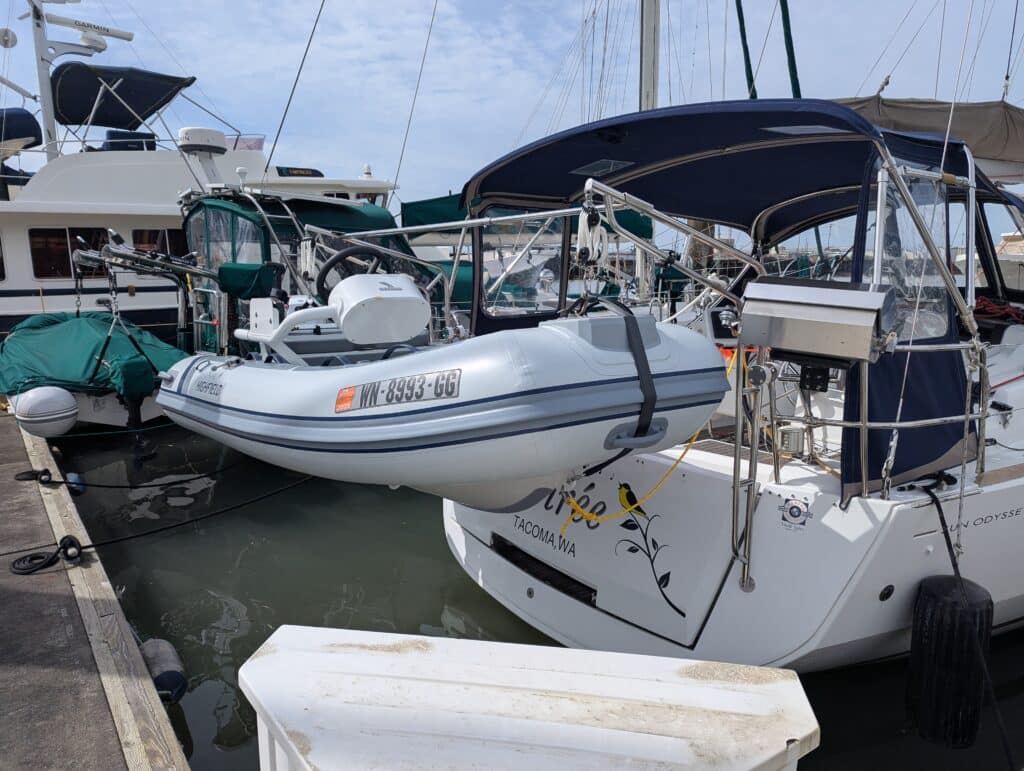
How to Choose Dinghy Davits by Tender Weight
The most common question we get is “Which davits do I need for my boat?” The honest answer is that the boat matters less than what you’ll hang from the davits. Davits are rated by the load they carry, so the right set depends on your dinghy, outboard and gear. Here’s how to work it out in five steps.
1. Add up the real load
The rated capacity of a davit set covers everything hanging from it, not just the dinghy. Add up:
- The dinghy or tender itself
- The outboard motor, if you leave it on the transom
- The fuel tank and fuel
- Oars, anchor, pump, cushions and anything else you leave in the dinghy
For example, a small inflatable at 90 lbs, a 60-lb outboard, a 25-lb fuel tank and 20 lbs of gear add up to 195 lbs. Use the weights from your manufacturers’ spec sheets, not guesses, and weigh the gear if you can.
2. Leave a margin for water and motion
Two things can push the real load well past that total. The first is water. A typical dinghy can hold about 26 cubic feet of water, which weighs roughly 1,345 lbs. That’s why the drain plug must come out every time the dinghy is lifted, without exception.
The second is motion. In a seaway, a tender swinging on its davits can put two to three times its static weight into the arms and the stern rail. Pick davits whose rating comfortably covers your total, and keep the dinghy tightly restrained underway.
3. Match the load to a davit set
| Davit set | Total capacity | Per arm | Height | Reach | From |
|---|---|---|---|---|---|
| MD-370 | 370 lbs | 185 lbs | 50 in | 38 in | $1,825 |
| MD-600 | 600 lbs | 300 lbs | 47 in | 38 in | $2,095 |
| MD-600EXT | 600 lbs | 300 lbs | 66 in | 38 in | $2,350 |
Choose the MD-370 for lighter tenders and small outboards, and the MD-600 once your total passes 370 lbs. The MD-600EXT carries the same 600 lbs but stands 19 inches taller, which helps when you need the dinghy higher above a swim platform, boarding ladder or high stern rail. If you also want solar power, the Solar Arch and Davits carries panels, dinghy and motor together, up to 800 lbs total.
4. Check your stern rail and mounting points
Davits put heavy loads into the stern rail and the deck or transom below it. Before you order:
- Measure your stern rail tube. Martek rail mounts fit 1.0, 1.125 and 1.25-inch rails.
- Push and pull firmly on the stern rail, fore-and-aft and side-to-side. If it moves, plan on Rail Support Arms (diagonal braces) from the rail to the deck.
- Plan a stabilizing strut between the arms (MD-370 or MD-600/MD-600EXT) to stop side-to-side movement.
- Make sure you can reach the underside of the deck or transom where the lower mounts go, so you can fit the backing plates. Never substitute screws for the supplied through-bolts.
- Split stern rails with a centerline walk-through may need extra bracing. Send us photos if yours is one.
5. Pick your lifting tackle
You’ll need a block and tackle at each arm to lift the dinghy. A 4:1 Hoisting Tackle Set suits lighter tenders. For heavier loads, a 6:1 Hoisting Tackle Set cuts the pull you need at the line. Add Cam Cleats to hold the lines and Ratchet Tie Downs to keep the dinghy from swinging.
When to take the dinghy off the davits
Davits are meant for carrying a tender in harbor, sheltered and coastal conditions. Before an offshore passage, or when seas build past about 4 feet, take the dinghy off and stow it on deck, and always remove the outboard first.
Still not sure?
Send us your dinghy and outboard models and a few photos of your stern, and we’ll recommend the right davits, struts and tackle. You can also see Martek davits on boats like yours: Catalina, Hunter, Beneteau, Jeanneau and trawlers. Contact us or call (727) 412-1002.